
Jaw clicking
A 'click' when opening or closing the mouth may be related to a change in the position of the articular disc. Clicking alone, without pain or catching, is common and does not necessarily get worse.
This page is an AI-assisted English translation that is under review by native speakers and medical reviewers. The Korean version is the reference. Questions: +82-2-6205-1236
Core care
Sounds from the jaw or the jaw moving to one side as you open your mouth may be related to many factors. At MODNI we check your symptoms and movement together and, based on the examination, explain what assessment and care you may need.
Last updated Medical review in progress
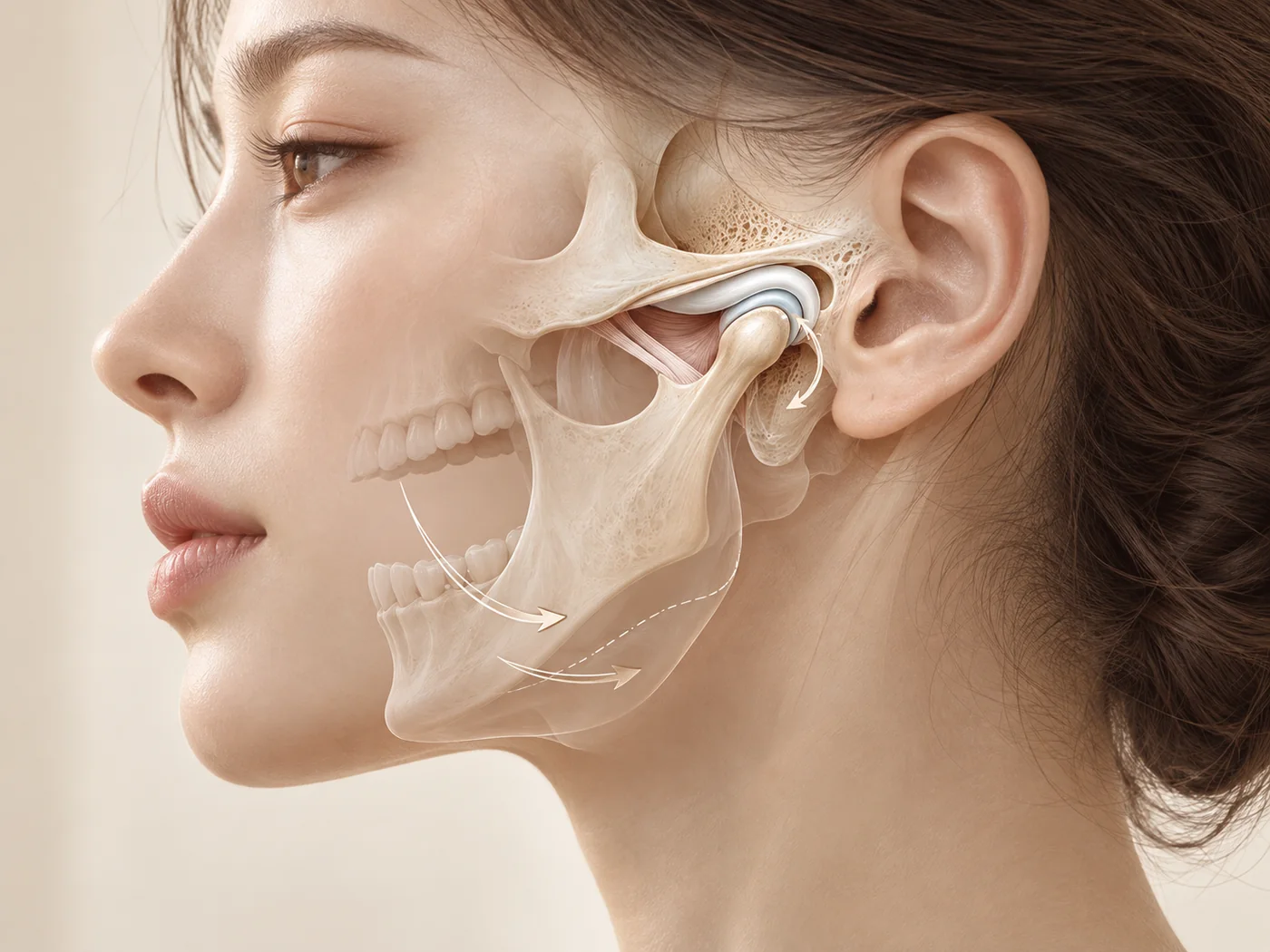
Temporomandibular disorders (TMD) is a collective term for pain, joint sounds and limited mouth opening affecting the temporomandibular joint (TMJ) and the chewing (masticatory) muscles. Clicking without pain or catching is common, and not all of it needs treatment. At MODNI, after checking how wide the mouth opens, the path of the chin, joint sounds, and tension in the chewing muscles, neck and shoulders, we choose or combine acupuncture, pharmacopuncture and Chuna therapy according to your condition, and also consider an oral appliance where needed.
The jaw joints are a left and right pair located just in front of the ears, where the temporal bone of the skull meets the lower jaw (mandible). Between the mandibular condyle — the upper end of the lower jaw — and the glenoid fossa of the temporal bone sits the articular disc, which helps the movement run smoothly.
When you begin to open your mouth, the condyle rotates in place; as you open wider, it moves forward beneath the articular eminence. Because both joints are connected through a single lower jaw, movement on one side affects the other. The illustration above is an explanatory drawing showing the location of the jaw joint and the direction of this movement.
A 'click' when opening or closing the mouth may be related to a change in the position of the articular disc. Clicking alone, without pain or catching, is common and does not necessarily get worse.
Pain in front of the ear, at the temples or around the jaw when chewing or opening the mouth. It is often pain in the surrounding muscles rather than the joint itself, so we check these separately.
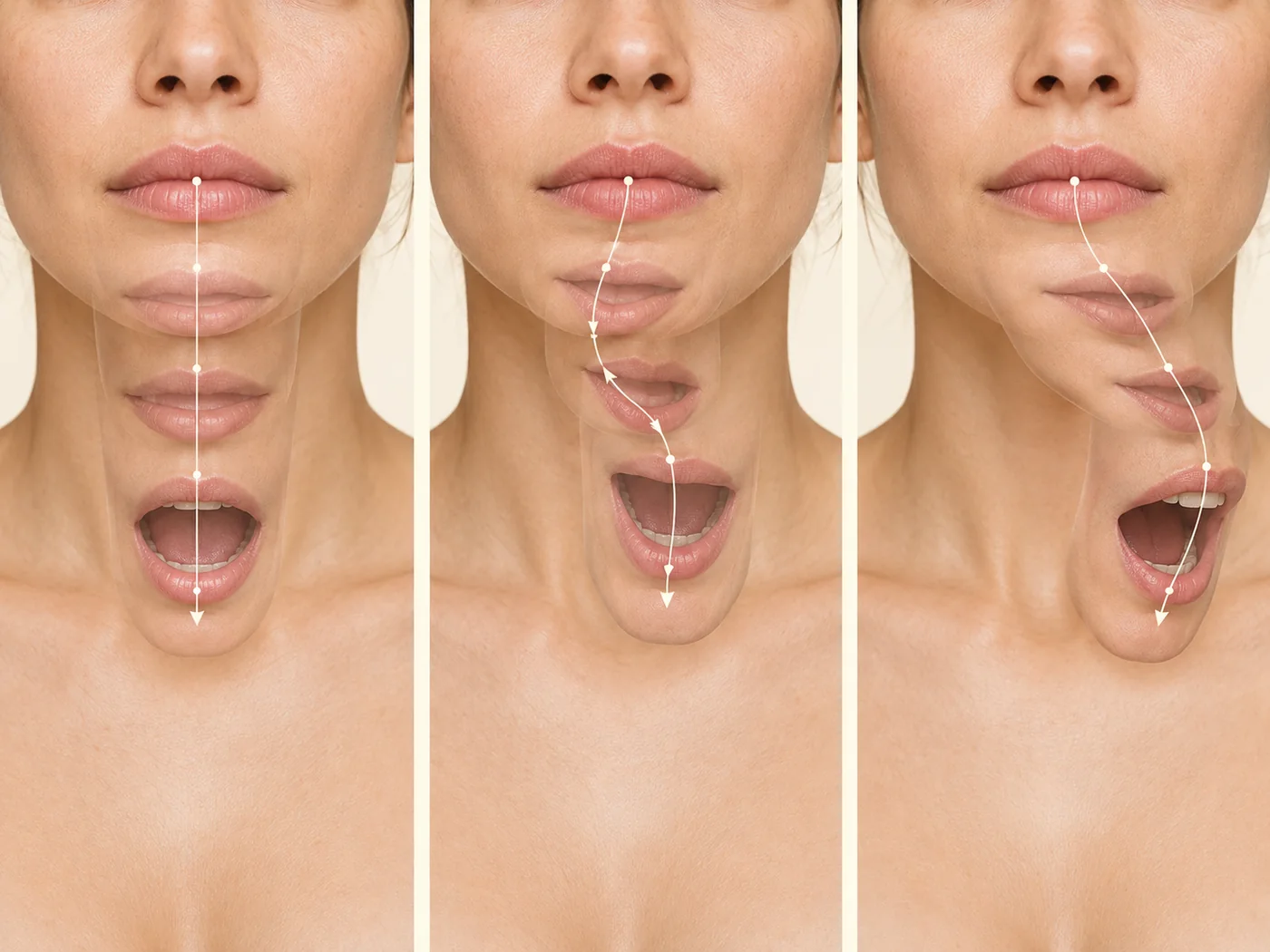
The chin may shift to one side midway and then return, or stay shifted as the mouth opens. Which side it shifts to, and at what point, gives clues for assessment.
The mouth opens less than usual or feels as though it catches midway. If you suddenly cannot open or cannot close your mouth, prompt medical care is needed.
Clenching or grinding, or habits of chewing for long periods, can tire the masseter and temporalis muscles. This may show up as a stiff jaw in the morning or heaviness around the temples.
Jaw discomfort sometimes occurs together with neck and shoulder tension. We also look at your sitting posture and head position.
Jaw discomfort is easy to get used to in daily life. If you notice any of the changes below, it is worth having your current jaw movement and muscle condition checked once. If the examination shows that monitoring is enough, we will tell you so.
Seen from the front, the chin generally comes down along the midline as the mouth opens. Small departures from this path are common.
A path that shifts to one side midway and returns at the end (deviation) and a path that stays shifted all the way open (deflection) may involve different factors. Whether pain, catching or reduced opening are also present is an important criterion for deciding whether treatment is needed.
| Item | What we check |
|---|---|
| Symptom history | Since when and with which movements it is uncomfortable, the character of sounds and pain, and habits such as clenching or grinding |
| Opening range | The distance between the upper and lower front teeth at comfortable and maximum opening. Maximum opening in adults is generally reported to be about 40 mm or more |
| Opening path | The path of the chin as the mouth opens and closes, and the direction and timing of any shift |
| Joint sounds | Which side the sound comes from and when (on opening or closing), and whether it comes with pain |
| Muscle palpation | Tension and tenderness in the masseter, temporalis, and the muscles around the neck and shoulders |
Jaw joint discomfort and left–right differences in the face sometimes occur together and sometimes do not. We do not assume in advance that they are related. If left–right differences in your face also concern you, we carry out a facial asymmetry assessment and a 3D facial record as well, and explain whether the two are related.
First-visit time
About 60 min
The director personally carries out the assessment, explanation, treatment plan, treatments and follow-up assessments. For simple jaw joint pain, the 3D facial surface scan can be skipped.
StandardIf needed
We ask where it is uncomfortable, when it started, the character of any sounds or pain, your habits, and past dental treatment.
We check how wide the mouth opens, the path of the chin, and joint sounds.
We check tension and tenderness in the chewing muscles and the muscles around the neck and shoulders.
Performed when left–right differences in the face are also a concern.
The director explains what was found, which factors appear to be involved, and whether care is needed.
We decide on treatment methods and when to reassess, and the first treatment is carried out if you agree.
The time required may vary with your history and the scope of the examination.
Acupuncture, pharmacopuncture and Chuna therapy are chosen or combined according to your condition. Not every jaw sound needs treatment, and responses to treatment differ from person to person.
What is it?
Acupuncture is applied to tense chewing muscles, around the neck and shoulders, and to related acupoints, with a mild electrical stimulus added if needed.
When is it considered?
The basic treatment when muscle tension and pain are the main issue.
What is it?
A small amount of a solution extracted and refined from herbal medicinal ingredients is injected into acupoints in the uncomfortable area. It is a different procedure from an intravenous (IV) injection or a vaccine.
When is it considered?
Considered when localized tenderness is clear; whether to use it is decided after the examination.
What is it?
A Korean medicine manual therapy in which the Korean medicine doctor uses the hands to assess and adjust the movement of the jaw joint, the joints of the neck, and the surrounding muscles.
When is it considered?
Used alongside other care when limited opening or a shift in movement appears to be involved.
What is it?
An appliance fitted to the teeth and worn inside the mouth.
When is it considered?
Considered together with other care when needed, such as when clenching or grinding appears to be involved. It is not a treatment applied to every patient.
Things you can try in daily life alongside care.
Clicking alone, without pain or difficulty opening, is common, and monitoring is often enough. If the clicking becomes more frequent or pain or catching develops, we recommend an examination.
It is planned at about 60 minutes. For simple jaw joint pain the 3D facial surface scan can be skipped, so the time may differ.
Sometimes they are and sometimes they are not. If both concern you, we check them together in one examination and explain whether they are related.
No. An oral appliance is an option we consider together with other care when needed, and it is not a treatment applied to every patient. If you already use an appliance from your dentist, please let us know and we will take it into account in the care plan.
It depends on your symptoms and response, so it is not fixed at the start. We check changes through reassessment and decide together.

Your doctor
Director Oh Kyung-seok, KMD
Graduate, College of Korean Medicine, Gachon University · The director personally provides care, from assessment through follow-up.
Last updated Medical review in progress
Have your current condition checked before the discomfort becomes something you simply live with. We check how wide and along what path your mouth opens, joint sounds and muscle tension, and explain the results and the scope of care you may need.
+82-2-6205-1236 · 2F, K Building, 626 Samseong-ro, Gangnam-gu, Seoul, Republic of Korea · Location & hours